
Council of Heads of Australasian Herbaria
Australian National Herbarium
Biographical Notes

|
|
Council of Heads of Australasian Herbaria | |
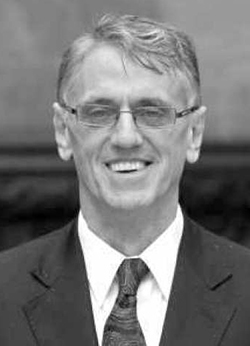 Burgman, Mark A. (1956 - )
He was born in 1956 in Wagga Wagga, NSW;
He received a BSc from the University of New South Wales in 1977.
He got an MSc from Macquarie University, Sydney, in 1981.
He was awarded a PhD from Stony Brook University in New York State, USA, in 1987.
His doctoral thesis, titled "The Habitat Volumes of Scarce and Ubiquitous Plants: A Test of the Model of Intermediate Disturbance," explored spatial distribution patterns and habitat requirements in plant populations, establishing early foundations in statistical modeling for conservation ecology.
He worked as a consultant ecologist and research scientist in Australia, the United States and Switzerland during the 1980s before joining the University of Melbourne in 1990.
He held the Chair of Botany in the School of Botany (later the School of Biosciences) at the University of Melbourne, and became the foundation director of Centre of Excellence for Risk Analysis (ACERA) on its establishment from 2006 to 2013.
After six years at Imperial College London, he joined the University of Hawai'i at Manoa in 2024.
He works on applying model-based risk assessment to problems in conservation biology. His research has included models of a broad range of species including giant kelp, orange-bellied parrots, Leadbeater's possums, bandicoots, and banksias.
He has worked in a range of environments including marine fisheries, forestry, irrigation, electrical power utilities, mining, and national park planning. Latterly he has worked on expert scientific judgements, and their unreliability.
He is author of 'Trusting Judgments: How to Get the Best Out of Experts' (2015).
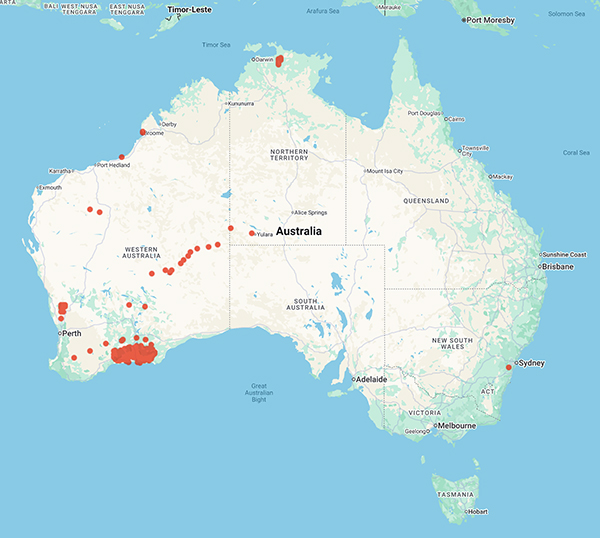
His herbarium collections are from 1978 to 1988, mostly lodged in PERTH or the John T. Waterhouse Herbarium (UNSW).
Source: Extracted from:
https://en.wikipedia.org/wiki/Mark_Burgman
https://grokipedia.com/page/mark_burgman
https://www.creativeprocess.info/one-planet-13-14/mark-burgman-mia-funk-g9tyk
https://profiles.imperial.ac.uk/m.burgman
Portrait Photo: Imperial College London.
Data from 1,949 specimens